
The Coaching Effect: Driving Momentum Through Change

In a recent Oxford Group webinar Damian Culhane (Head of Coaching at Oxford Group) and Sally Domingo-Jones (Consultant & Coach), explored a challenge that feels increasingly familiar to most organisations: how to sustain performance in a world of constant change.
Their core message during the conversation was clear, this wasn’t about new frameworks for the sake of it – it was about confronting a reality many leaders are already feeling:
We don’t have a strategy problem. We have a behaviour problem.
As Damian put it simply:
“The real challenge is not strategy – it’s embedding the change in day-to-day behaviour.”
The Reality: Change Is Saturating the System
One of the most striking points in the session was just how much change people are experiencing.
- In 2016, the average employee dealt with around two change initiatives
- By 2022, that number had risen to around ten
- Today, it’s estimated to be closer to 15-16 concurrent changes
That’s not just an increase – it’s a completely different operating environment.
Leaders are expected to deliver results while driving transformation. Teams are expected to adapt constantly, often without the time or space to process what’s changing. And organisations, they keep pushing forward, sometimes without resetting how work gets done.
The result is predictable: fatigue, disengagement, and stalled transformation.
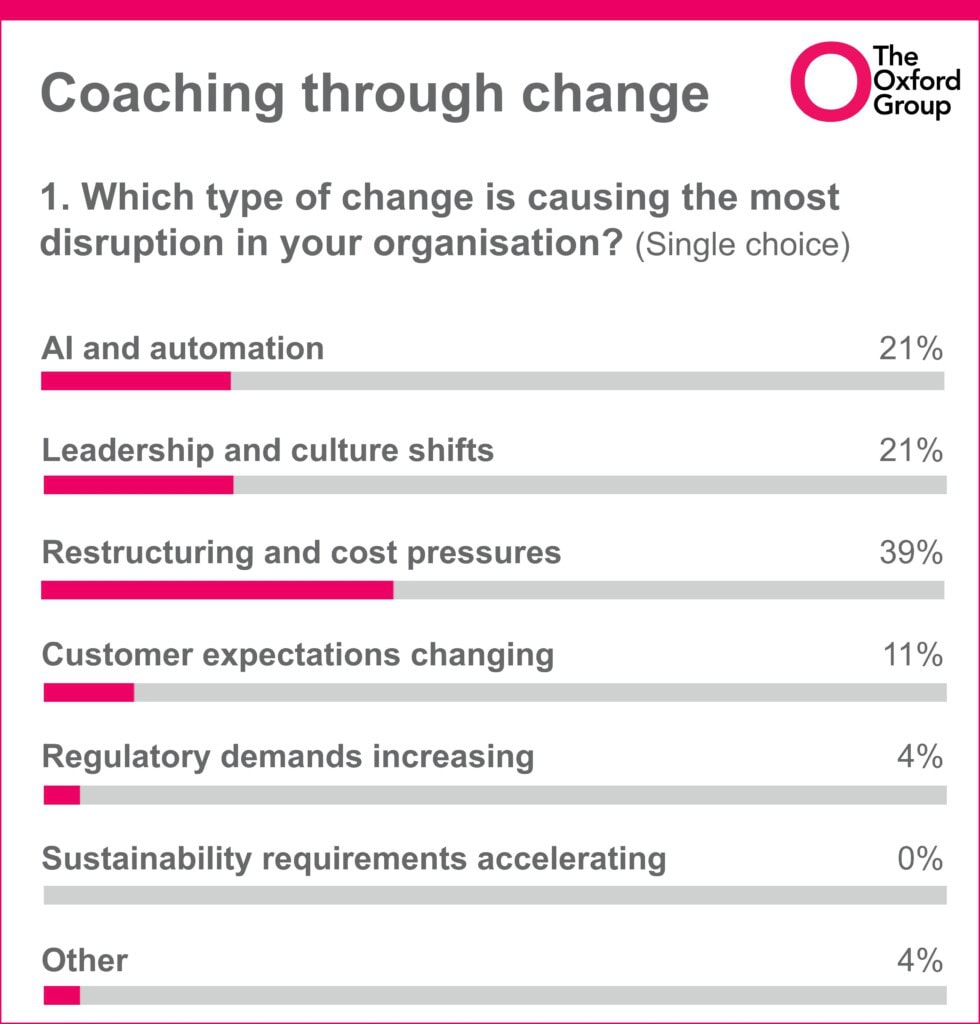
During the webinar we ran a poll for participants to vote on the type of change causing the most disruption in their organisation – see below for the findings:
Why Change So Often Breaks Down
Attempting transformation using the same habits that created the current state, will often lead to failure.
Engaging with participants in the chat, other common breakdown points came up repeatedly:
- Leaders communicating change before fully aligning themselves
- Limited space for reflection or emotional processing
- Teams losing connection during uncertainty
- Change feeling like something done to people, rather than something they shape
Deborah Rowland’s perspective added another layer:
Organisations seek “a new what” using “the same how” and that rarely works.
Coaching as the Missing Link
A key theme of the conversation was: coaching isn’t a nice-to-have – it’s a strategic capability.
Not because it sounds good, but because it directly addresses the gap between intention and action.
Damian and Sally described three practical ways coaching makes a difference:
1. Creating space in high-pressure environments
Coaching introduces structured reflection – something most organisations simply don’t have enough of.
2. Building ownership and agency
It shifts people from passive recipients of change to active participants.
3. Turning insight into sustained behaviour
As Ron Caricci’s idea suggests:
“Everyone wants the revelation to be the redemption.”
But coaching ensures that insight actually translates into action – and sticks.
Or, as Damian framed it:
“Coaching turns change from something that is happening to us, into something that we can actively drive.”
What This Looks Like in Practice
One of the strengths of the session was the range of real examples shared.
- A senior leader navigating a merger rediscovered her sense of value through coaching, reconnecting with purpose and external support
- A middle manager struggling with corporate messaging found his own “change why,” enabling more authentic communication
- A team leader in financial services moved from detail overload to strategic leadership by redefining output standards
- A newly promoted manager shifted their identity from “enforcer” to “implementer” – and saw an immediate lift in team engagement
- An individual contributor used a mountaineering metaphor to transfer confidence from outside work into navigating uncertainty
Across all of these, the pattern was consistent: reflection → reframing → deliberate action.
- Einstein reframe: The challenge is shifting consciousness, not just thinking, to solve today’s problems
- Simon Sinek’s tipping point: 18% early adopters triggers a cascade – once ~50% are on board, the rest follow
What the Research Tells Us
This isn’t just anecdotal – it’s backed by strong research:
- Google’s analysis of over 10,000 data points shows that being a good coach is the number one manager behaviour linked to performance, engagement, and retention.
- Gallup (2026) found that highly engaged organisations see:
- +18% productivity
- +23% profitability
- -78% absenteeism
- -21% turnover
- HCI & ICF (2023) highlight that coaching is a scalable management capability, not an elite perk.
From Coaching Interventions to Coaching Cultures
One of the most important shifts discussed was moving beyond one-off initiatives.
A coaching culture isn’t about running programmes—it’s about embedding behaviours:
- Leaders actively receive coaching themselves
- Coaching shows up in everyday conversations
- Curiosity and accountability become visible norms
- Systems are built to support ongoing practice, not isolated sessions
- Coaching cultures are built on systems, not sessions.
Practical Takeaways for Leaders
If there’s one thing to take away from the session, it’s that small, consistent shifts matter more than big one-off efforts.
Here’s where to start:
- Position coaching as performance-driven, not remedial
- Invest in middle managers – they’re the critical bridge between strategy and execution
- Focus on behaviour change, not just communication
- Create ongoing rhythms (peer coaching, reflection sessions, team dialogue)
- Measure impact over time – look at engagement, retention, productivity, and behavioural shifts
Final Thought
The session had a simple but powerful message:
Organisations don’t fail to change because they lack ideas. They fail because behaviour doesn’t keep pace with ambition.
Coaching closes that gap.
And in a world where change isn’t slowing down anytime soon, that might just be the capability that makes the difference between reacting to change – and actually leading it.
References
- Gallup Global Engagement Survey (2026)
- Human Capital Institute (HCI) & International Coaching Federation (ICF) Study (2023)
- Google Project Oxygen Findings (2025)
Sources and Further Insights
Gartner (via Harvard Business Review) – Employees are losing patience with change initiatives
Reports that the average employee experienced 10 change initiatives in 2022, up from 2 in 2016
Rowland, D. & Higgs, M. – Sustaining Change: Leadership That Works
Brown, B. – Strong Ground (concept from her work on grounded leadership and resilience)
Connect with Damian
If you’d like to discuss how coaching can help your teams at all levels, Damian Culhane is here to support you on a 1 to 1 call – contact damian.culhane@oxford-group.com to book a free session.
Watch the webinar on-demand
Damian Culhane and Sally Domingo‑Jones explore how coaching becomes a powerful anchor during continuous change—creating space to think, challenging legacy mindsets and building resilience so individuals and teams can navigate transformation with confidence. They share practical examples of coaching driving meaningful behaviour change, strengthening leadership capability, keeping teams connected and encouraging reflection, ownership and renewed energy. A core theme is that change often happens to people rather than with them, and coaching helps reconnect individuals with purpose, values and agency, making transformation more human and sustainable. If you’re leading change or supporting teams, this recording offers valuable insights you can apply straight away.